
Air Duct Repair
Conditioned air you already paid for should arrive in your rooms — not in your attic. We find the leaks, the disconnects and the crushed runs, and we fix them properly instead of wrapping them in tape.
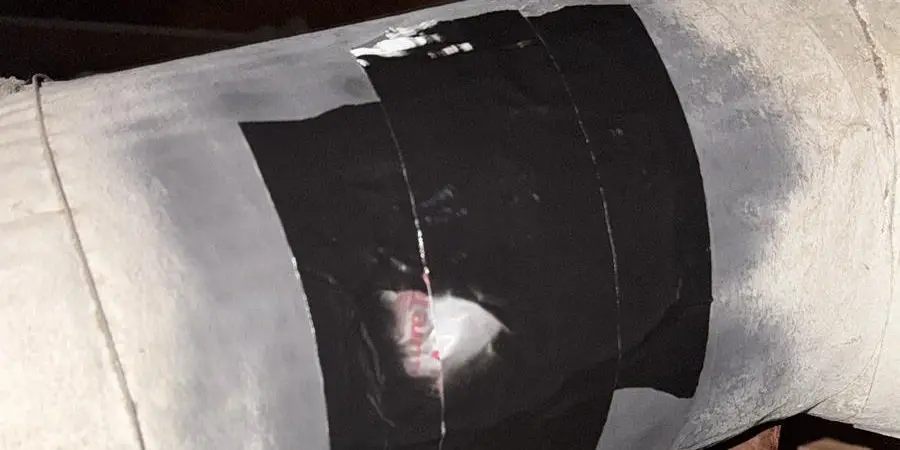
The quiet leak that shows up on your energy bill
Duct systems fail in undramatic ways. A flex run pulls loose at a boot and vents into the attic. A joint that was never mastic-sealed opens up as the metal expands and contracts through a decade of summers. Insulation slumps off the top of a line and the air inside it warms up before it ever reaches a register. Nothing breaks loudly, and nothing on your thermostat tells you.
The US Department of Energy estimates that in a typical house with ducts running through unconditioned space, roughly 20 to 30 percent of the air moving through the system is lost to leaks, holes and poorly connected joints. That is a fifth to a third of your heating and cooling paid for and thrown into an attic, and it is also the reason one bedroom never keeps up while the hallway is freezing.
Repair is the least glamorous and often the highest-value service we offer. It does not photograph as dramatically as a cleaning, but it is frequently what actually fixes the complaint that brought us to the house.
What the service includes
- Full leak survey of the accessible system — joints, boots, plenums, takeoffs, splices and returns, with photographs of every defect found.
- Mastic sealing at joints and seams, reinforced with mesh where the gap requires it, rather than fabric duct tape that dries out and lets go.
- UL 181 listed foil tape where tape is the correct material for the connection.
- Disconnected and separated runs reconnected and mechanically fastened, not pushed back on and hoped for.
- Torn flex liner and punctured jackets repaired, or the section replaced when the damage is past patching.
- Crushed, kinked and sagging lines re-routed and re-supported with proper strapping so airflow is restored, not just the appearance of a straight duct.
- Insulation restored on repaired sections so newly sealed lines do not simply lose their temperature instead of their air.
- Registers, boots and grilles re-seated and sealed to the drywall or subfloor where they have opened up.
- Before and after photographs of each repair, with a written summary of what was found and what was done.
What sealed ductwork gives you back
The first thing most homeowners notice is comfort, not cost. Rooms at the end of long runs finally reach temperature, the system stops cycling for hours to satisfy a thermostat it could never quite reach, and the difference between rooms narrows. The second thing is dust: a leaking return pulls unfiltered attic, crawlspace and wall-cavity air straight into your air handler, and sealing it removes a source that no filter upstream can protect you from.
There is a safety dimension as well. Return-side leaks change the pressure balance of the house, and in homes with gas appliances, a badly unbalanced system can work against proper draft. Sealing the return side and restoring balanced airflow is basic building science, and it is part of every repair we quote.
We will always tell you when repair is the wrong answer. Once a system has failed at many points, has been repeatedly patched, or has liner deterioration through most of its length, sealing it is money spent on borrowed time — and we will price replacement instead and let you compare the two honestly.
Signs you need this service
- One or more rooms that never reach the temperature the thermostat is set to
- Energy bills climbing while your habits and equipment have not changed
- Visible dust streaking around register edges, or dust re-appearing days after cleaning
- A whistling, roaring or rattling sound near the air handler or in the ceiling
- Ductwork visibly disconnected, kinked, sagging or lying on the attic floor
- Attic or crawlspace smells that arrive indoors when the system runs
- The system runs almost constantly in mild weather
Find it, seal it, prove it.
Repairs are only as good as the survey in front of them — so we look first, quote second, and photograph everything.
Survey
We walk the accessible system, check airflow and static pressure, and inspect joints, boots and returns with a camera and a light. Every defect is photographed and listed on the quote with a plain description of the consequence.
Seal and reconnect
Joints and seams are mastic-sealed, disconnected runs are reconnected and fastened, punctures are patched or the section is replaced, and sagging lines are re-supported to restore the full internal diameter.
Re-insulate
Repaired sections get their insulation restored so the air keeps the temperature you paid to give it. Boots and register openings are sealed back to the building surface.
Re-check
We restart the system, re-measure airflow at the registers we were called about, and hand over photographs of every repair alongside the written guarantee.
Air Duct Repair: common questions
Straight answers, no pressure. Call us if yours is not here.
Aerosol internal sealing exists and has its place, but it is not a substitute for reconnecting a run that has fallen off a boot or re-supporting a crushed line. We prefer mechanical repair at the defect, which we can show you in a photograph and you can point to later.
It comes down to how many defects there are and the condition of the material between them. A handful of open joints and a couple of loose boots is a repair. Deteriorated liner throughout, decades-old duct board that is shedding, or a system that has been patched five times already is a replacement — and we will quote both so the comparison is yours to make.
Sealing removes waste, and in a leaky system that waste is significant — the DOE puts typical loss at 20 to 30 percent of airflow. What we will not do is print a guaranteed percentage on your invoice, because savings depend on your equipment, insulation, thermostat habits and climate. Comfort improvement is usually immediate and obvious.
No. Cloth duct tape is not rated for duct sealing and dries out and releases. We use mastic with mesh reinforcement, or UL 181 listed foil tape where tape is the appropriate material.