
Air Duct Cleaning
The foundation of everything else we do: every supply, every return, every inch of trunk line brushed loose and pulled out of the house under HEPA-filtered negative pressure — not blown around it.
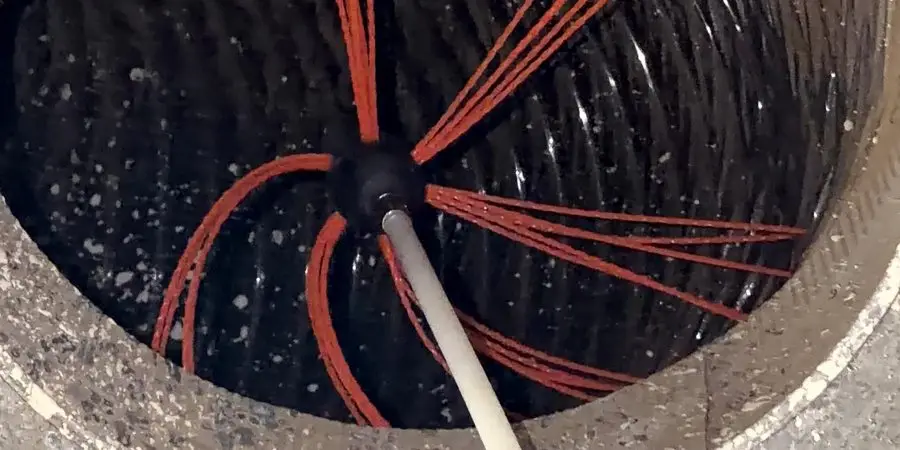
Cleaning that removes, rather than redistributes
A duct system is a closed loop that touches every room you breathe in. Over the years it collects construction dust, drywall fines, pet dander, pollen, insulation fibres and the fine grey film that settles wherever air changes direction. None of that leaves on its own. Every time the blower starts, a portion of it lifts and travels.
Real cleaning is a mechanical process, not a fragrance. We agitate the interior surfaces of the duct with rotary brushes and compressed-air whips, and at the same time we hold the entire system under negative pressure with a HEPA-filtered vacuum so everything that comes loose is captured and carried outside the building envelope. That combination — agitation plus containment — is what the industry calls source removal, and it is the only approach we use.
The work is finished when the system is clean and documented: sealed access points, a photographed interior before and after, and a plain-language report of what we found. If we discover something that cleaning cannot fix — a crushed run, a torn liner, a mould colony on a cooling coil — you hear about it that day, in writing, with options and no pressure.
What the service includes
- Full system, not a room count. Every supply register, every return, the plenums and the main trunk lines.
- HEPA-filtered negative pressure maintained on the system for the entire cleaning, so dislodged debris leaves the house instead of settling in it.
- Mechanical agitation with rotary brushes and air whips sized to each duct type — rigid metal, flex, or duct board.
- Register and grille cleaning — removed, washed, dried and reinstalled, not wiped in place.
- Blower compartment, coil face and drain pan inspection, with photographs of anything that needs attention.
- Low-VOC botanical sanitizing on request — no bleach, no chlorine fog, safe for children and pets once dry.
- Access ports sealed to standard and every opening we make closed and labelled.
- A written report with before and after photos of the interior of your ductwork, emailed the same day.
What duct cleaning does — and what it honestly does not
Cleaning removes the reservoir. It takes the settled dust, debris and biological material out of the airway so the system stops re-circulating it, and it restores airflow through registers that have been quietly choking on lint and pet hair. Homes with recent renovation dust, visible debris at the registers, rodent or insect activity, water intrusion, or a musty smell that appears the moment the system starts are the homes where the difference is immediate and obvious.
We will also tell you what it will not do. The EPA is clear that routine duct cleaning has not been shown, on its own, to prevent health problems in an otherwise clean and dry system — its guidance is to clean when there is visible mould growth, vermin, or substantial deposits of dust and debris. Cleaning is also not a cure for a system that is leaking conditioned air into the attic, running with the wrong filter, or fighting a coil that has never been serviced. Those are separate, fixable problems, and we would rather point you to the right repair than sell you a cleaning that cannot solve it.
That is why every visit starts with an inspection and a quote, not a truck-mounted hose. If your ducts do not need cleaning, we will say so.
Signs you need this service
- Visible dust or debris blowing from the registers when the system cycles on
- A musty or stale odour that appears within seconds of the blower starting
- Renovation, drywall or sanding work anywhere in the house in the last two years
- Evidence of rodents, insects or nesting material in the attic or crawlspace
- Rooms that never quite reach temperature while the filter loads up unusually fast
- Water intrusion, a flooded attic, or a history of condensation around the air handler
- You have moved into a home and have no record of the ducts ever being serviced
Assess, clean, document.
The same careful sequence in every home — nothing quoted over the phone, nothing adjusted upward mid-job.
Assess
We scope the system with a camera, check static pressure and airflow at the registers, look at the coil, filter and drain pan, and photograph what we find. You get an itemized written quote before anything is opened.
Contain
Access ports are cut where they belong, the HEPA collection unit is connected, and the system is placed under continuous negative pressure. Floors and furnishings are protected before the first brush turns.
Clean
Rotary brushing and air-whip agitation run duct by duct, with registers and grilles removed, washed and dried. Optional low-VOC sanitizing is applied last, on a clean surface, where it can actually work.
Verify
Access points are sealed, the system is restarted and re-checked, and we photograph the same interior sections again. The report and the guarantee arrive in writing the same day.
Air Duct Cleaning: common questions
Straight answers, no pressure. Call us if yours is not here.
For a dry, well-filtered system in a stable home, every three to five years is the common industry interval, and the EPA sensibly ties the decision to condition rather than the calendar. Pets, allergies, recent construction, smoking, or a home in a dusty corridor pull that interval shorter; a sealed newer home with a good filter can go longer.
We will not promise that, and you should be sceptical of anyone who does. What cleaning does is remove the reservoir of dust, dander and debris that the system has been re-circulating, and restore airflow. Many households notice less settled dust and a fresher first minute after start-up. Medical outcomes depend on far more than ductwork.
Only if you ask for sanitizing, and only with low-VOC botanical products applied to already-clean surfaces per the label. We do not fog bleach or chlorine into a duct system, and we do not use scent to imply cleanliness.
Yes. We photograph the interior of the same duct sections before and after, and the images are part of the written report that reaches you the same day, along with anything we recommend and anything we found that cleaning could not fix.